Thank you for writing to us. One of our executive will reach back to you through your submitted medium. In case there’s an urgency, feel free to connect over WhatsApp for faster response.
Prefer calling? Dial +918048045969 (International callers) or 08048045969 (Indian callers).
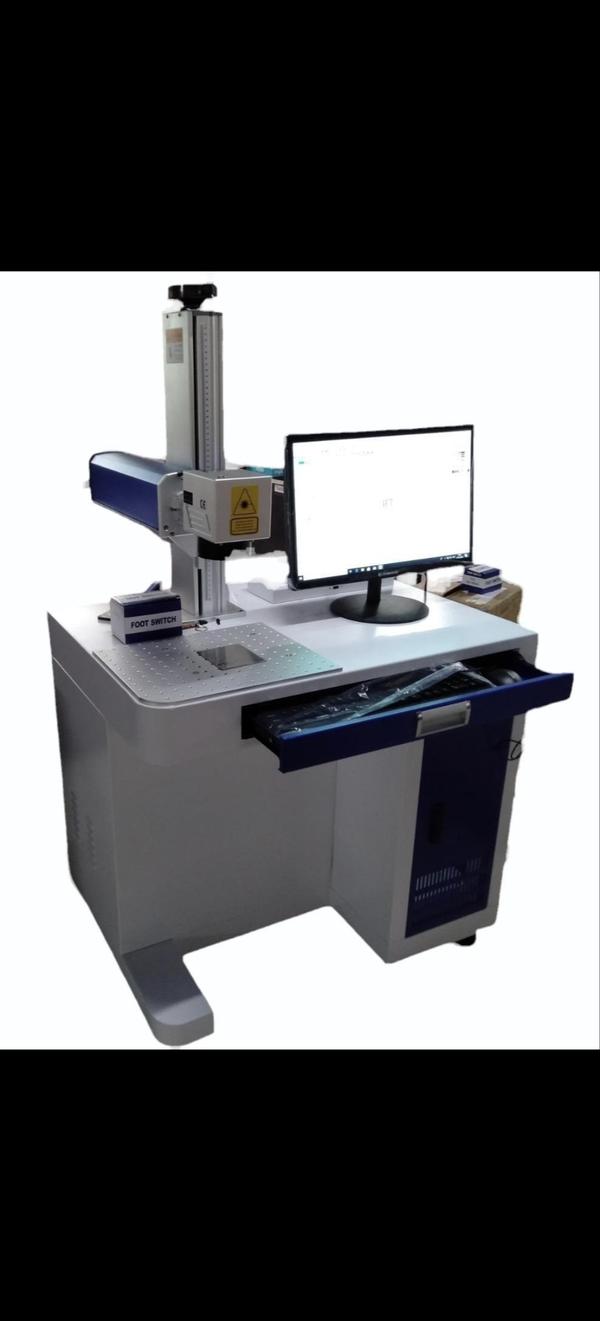
A laser marking machine is an advanced, non-contact industrial tool that utilizes a focused beam of concentrated light—generated by laser sources like Fiber, \text{CO}_2, or UV—to create permanent, high-contrast marks on various materials. The core function is to alter the material's surface properties or appearance through processes such as engraving (removing material), etching (creating a shallow, high-contrast mark), or annealing (changing color through localized heating without material removal). These machines are essential across industries like automotive, aerospace, electronics, and medical devices for traceability and identification, producing durable markings that withstand abrasion, chemicals, and heat, including alphanumeric serial numbers, logos, and machine-readable 2D codes (like QR and Data Matrix codes). Controlled precisely by software and often incorporating a high-speed galvanometer system, the laser marking machine offers unmatched accuracy, speed, and versatility over traditional methods, ensuring the mark remains intact for the product's entire lifecycle.
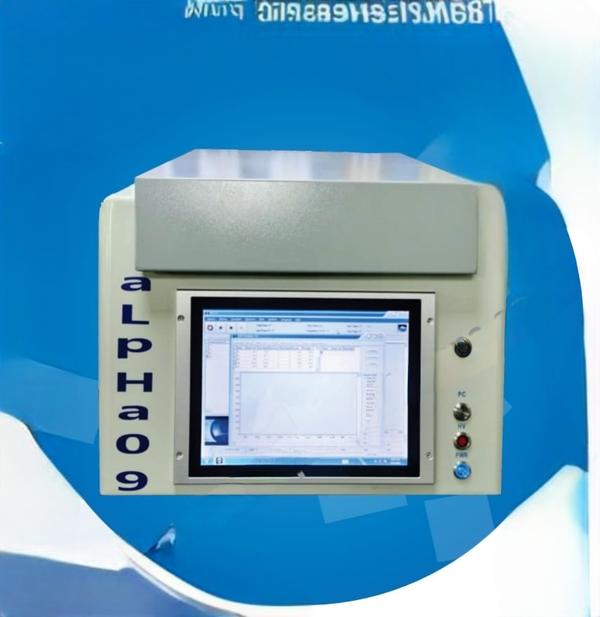
The product is an advanced X-ray Fluorescence (XRF) Analyzer designed for the rapid and precise elemental analysis of various samples, including solids, powders, and liquids. It operates using an X-ray tube with an adjustable voltage range of 5\text{KV} to 50\text{KV} and a current of 1\text{mA}, coupled with a Proportional Counter tube detector. The instrument is highly accurate, achieving a relative standard deviation (RSD) of \le 0.1\%, and can analyze concentrations from 1\text{ppm} up to 99.99\%. It is specifically configured to measure 17 elements, prominently including precious metals like Rhodium (Rh), Gold (Au), Silver (Ag), Platinum (Pt), and Palladium (Pd), along with base metals such as Nickel (Ni), Copper (Cu), Zinc (Zn), Cadmium (Cd), and Indium (In). An HD camera assists with sample positioning within the 280 \times 280 \times 80\text{ mm} chamber, and analysis times are very fast, ranging from 10 to 50 seconds. The analysis is managed by dedicated KEY qualitative and quantitative analysis software, and the unit is a relatively compact benchtop device, weighing 27\text{kg} with external dimensions of 430 \times 430 \times 370\text{ mm}.